Fertility 26 – Highlights from Edinburgh
The annual joint fertility conference this year was a three-day immersion in all aspects of fertility, from egg freezing, world population decline and patient support, to fertility politics, environmental chemicals as well as poster displays on a myriad of topics.
Professional Development
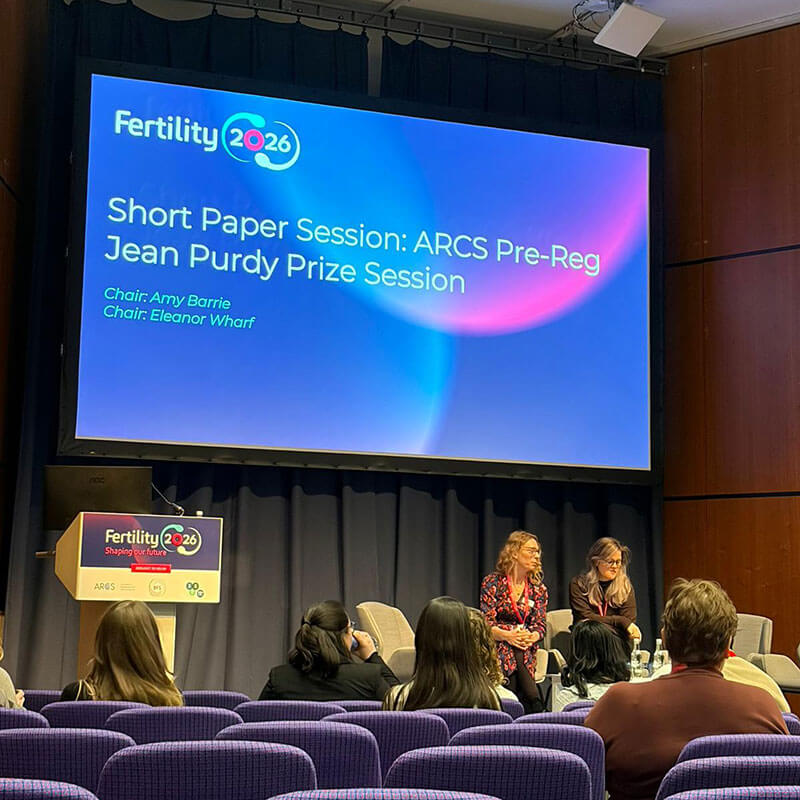
It was a privilege to Chair the Jean Purdy pre-registration prize session, as well as marking posters and organising the ARCS stand this year. I’m especially proud to be leading the EDI network for ARCS, and it was great to see Fertility 26 achieve Gold Accreditation for Neuroinclusive Events, making it an inclusive, accessible and very welcoming environment for everyone to learn and participate.
The role of AI in Reproductive Science
Intelligent automation of the IVF process is a trending topic and the subject of Jacques Cohen’s lecture on the rise of artificial intelligence (AI) in IVF labs. An increase in precision, consistency and workflow efficiency is welcome, but much of the research so far focuses on modelling rather than improved live birth rates. In addition, these technologies should be seen as tools to support Clinical Embryologists and Andrologists, rather than a replacement of these roles.
A Global perspective
Global fertility rates are declining. With lower infant mortality, couples are choosing to invest all their resources into one or two children who are much more likely to survive into adulthood. Furthermore, better education, particularly for women, leads to delays in childbearing. Professor John Aitken covered a lot of ground in the Bob Edwards Memorial Lecture, with fertility rates falling faster than natural reproductive biology can compensate, and the population of China set to halve in the next generation alongside an epidemic of loneliness, he proposed we may need assisted reproduction more than ever.
Patient Support
Having a positive pregnancy test is not the end point, as we were reminded by Sarah Banks in the Patient Update session on Thursday afternoon. Being careful with language used (‘congratulations’ may feel triggering for those who have experienced baby loss), normalising feelings of anxiety, and ensuring patient notes have been read in preparation for a phone call were all important take-homes for fertility professionals. Providing clear information and continued access to emotional support are key at this stage in a patient’s treatment.
Reproductive freedom and social justice
On the final day we took a step into social science with Lisa Campo-Engelstein from the Department of Bioethics and Health Humanities at the University of Texas. She reminded us “reproductive freedom is a matter of social justice, not just freedom of choice.” Treatment for male factor infertility mostly happens on women’s bodies – the burden lies with women even though infertility is a couple’s disease. Same-sex couples have to give extra evidence to prove fertility issues. ‘Social’ egg freezing is promoted as enhancing womens’ autonomy, yet freezing eggs does not address the actual issue of difficulty finding a partner, or create more support for single mothers. Rather, the burden is firmly placed on individual women to navigate, and allows blame to be unfairly placed on women who don’t freeze their eggs.